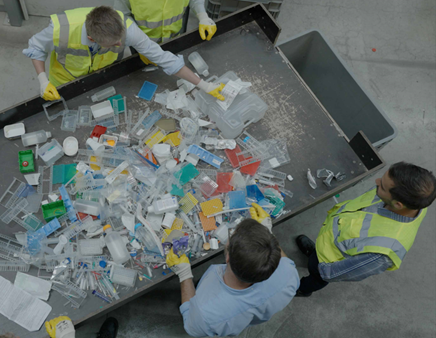
Building upon the insights gained from the initial pilot study conducted in the Netherlands, HPRC Europe has completed a second-phase study based in Germany to investigate the feasibility and effectiveness of collecting and sorting healthcare plastic packaging waste at a more industrial-scale utilizing automated sorting technologies.
Case Study
Unlocking Recycling Potential: A Healthcare Plastic Packaging Sorting Pilot
The original pilot demonstrated that with appropriate sorting technology and waste stream management, healthcare plastic packaging can be efficiently segregated as a relatively pure fraction suitable for recycling. This foundational work highlighted both the technical possibilities and emerging challenges associated with scaling such solutions to commercial levels.
The current study seeks to further investigate and enhance these findings by utilizing real-world, non-contaminated healthcare plastic packaging waste collected under controlled conditions to ensure sample integrity. The primary objective is to assess whether automated sorting systems can reliably process these materials at an industrial scale with sufficient accuracy and throughput to support sustainable recycling operations. The study will provide evidence-based findings for the collection, logistics, and handling of healthcare plastic packaging waste and look at ways to optimize the interface between waste generation points and recycling facilities.
By focusing on real-world waste streams and testing within the parameters of existing industrial infrastructure, this research endeavors to bridge the gap between theoretical feasibility and practical implementation.
Download the Full Report Here
Download
Participants
The project brought together partners with complementary expertise across the healthcare plastics value chain. HPRC coordinated the initiative, while CIRCULARMED played a crucial role in connecting the team with Universitätsklinikum Bonn (UKB) and TOMRA, securing access to hospital waste streams and advanced sorting facilities. UKB provided real-world materials for testing, and TOMRA hosted the trials. HPRC members DuPont, Amcor, LyondellBasell, Eastman, Baxter, and Nelipak were among key contributors to the project
First Pilot: Manual Sorting in the Netherlands
In 2024, HPRC partnered with UMC Utrecht and NTCP to manually sort a small batch of healthcare plastic packaging waste. The pilot confirmed that clean, segregated packaging can be efficiently sorted into recyclable streams using existing hospital workflows.
While technically feasible, challenges included point-of-use sorting complexity, staff engagement, contamination control, and the need for sufficient volumes to achieve scale. These insights informed the next phase, which introduced automated technologies to improve efficiency.
Second Pilot: Automated Sorting in Germany
The second phase, conducted with Universitätsklinikum Bonn and TOMRA, tested automated sorting of rigid and flexible plastics under real-world conditions.
This trial provided key insights into technical performance, contamination risks, and pre-treatment improvements, helping define best practices for scalable healthcare plastic recycling.
Key Insights:
- Importance of Waste Stream Quality: The study successfully sorted healthcare packaging waste into flexible and rigid formats using equipment similar to commercial facilities, though typical conditions would involve compaction and size screening for greater efficiency. Despite being non-hazardous, hospital waste poses contamination risks, and reprocessing methods for such waste are costly and require specialized facilities.
- Automated Sorting Process Efficiency: The trial recovered 45% of rigid materials into PP, PE, and PET streams, while 55% were rejected for incineration; proper pretreatment could improve recovery rates. Flexible packaging was sorted into PE, but multi-material films risk contaminating recycling streams, making mechanical recycling less viable and highlighting chemical recycling as a costly yet effective alternative for producing virgin-quality material.
- Tips for Waste Separation: Sorting healthcare plastic waste at the point of use is challenging but could improve outcomes, especially with tailored approaches based on material type and form. Future solutions may include AI-based object recognition to enhance sorting and reduce contamination, though success also depends on trained staff and proper hospital systems.
- Smarter Design for Better Recycling: Designing packaging and medical devices for recyclability, as recommended by HPRC’s Design Guidance, is key to improving sorting and recycling efficiency. This approach enhances the value of the waste stream, making it more attractive to waste management companies and creating potential revenue for hospitals.
Download the Full Report Here
Download